Manifesto of the Renovation
OFFICIAL NOTE ON THE RESTORATION WORK
Villa Forni Cerato Foundation is the guarantor of the conservative archaeological restoration of the homonymous World Heritage Monument, which is based on three principles:
1. Do not allow any transformation or reuse. We want to keep the place unchanged for use as a museum of oneself, a place of constant research and insights, and certainly of continuous new discoveries.
2. Aim for an EXEMPLARY restoration, that is transparent, documented, imitable, because it has to be shy, perennial and participative.
❖SHY
SHY,therefore non-invasive, but purely conservative, without additions of electric light, water, or heating. Here no transformation is allowed: a monument has the function of "memory" and "testimony," and the insertion of new functions "small or large, visible or not, modern or classical" could betray it. Nothing from us contemporaries must remain after the conservation work on the historical asset. But a building with 450 years of life requires a structural consolidation intervention, and this necessarily implies invasive activities. It is like a surgery performed by a team of doctors on a very elderly patient: surely the surgeon insists on transplanting younger internal organs, just as the structural engineer intends to consolidate the stability of the asset, while the plastic surgeon would like to reconstruct aesthetic functions, eliminating the wrinkles that are instead a natural sign of age; here the only objective is to keep the Monument intact over time, protect it from bad weather or vandalism, and guarantee the safety of the visitor."
❖eternal
eternal... , so that the Villa is never again abandoned to itself. The restoration aims to bring the object of intervention back to its original appearance, without any haste, freeing it from accretions that make its characteristic stylistic intent difficult to read. The reinstatement must be carefully weighed and evaluated, based primarily on the importance and the documentary and historical value of what one intends to reconstruct. Any minimal choices of ours that might create modifications must be well documented, having philological, objective, and irrefutable motivations. Since future research may suggest different and better choices than the current ones, it is certain that every detail must always be extensively documented, just like a scientific experiment, certifiable and repeatable. Within a dialectic inspired by doubt and therefore by a critical debate on the different options, one must always be aware that, when faced with a conservation problem, it is necessary to approach it in a non-prejudicial or dogmatic manner, avoiding the superimposition of theoretical propositions onto a constantly changing reality that can therefore never be inscribed within predetermined typologies. The knowledge acquired, the critical reflections, and the experiences accumulated during the course of the work program must be considered the heritage of anyone who cultivates similar interests.
❖PARTICIPATIVE
PARTICIPATIVE, the work of multiple experts and never of a single individual. There are and there will be choices to make, both for the conservative restoration and for the structural consolidation. The Architect Designer and Director of Works must list the various problems, possibly adding a proposed solution of their own, so that each participant of the Working Group can propose their own thoughts on the design choice, in a dialectical form, through debate, perhaps even in a conflictual form. These observations of the problems must derive from the comparative reading of various studies: the surveys of the current state, the analyses of the tests performed, the results of historical research, whether written or graphic, and the critical literature on Villa Forni Cerato and on the works of Palladio.
It is necessary that the members of the Working Group be able to compare their choices with a Discussion Table, the broadest and most competent possible, free from conditioning or interests that are not of a cultural nature. Around the table, structural engineers, architects, restorers, wood artisans, historians, laboratory chemists and physicists, experts in dendrochronology, archaeologists, as well as skilled craftsmen will engage in debate. We want the experts to be able to discuss publicly what is right and what is not right to do; only in this way will the Working Group become free to carry out an exemplary conservative restoration.
3. Respect the place as "sacred", reserved for those who know Palladio and love art, architecture, history. Villa Forni Cerato is a monument not suitable for crowds of tourists and forbidden to "customers"; nothing will be done to attract them with events not compatible with this monument. Precisely from the delicacy of this monument and the awareness that there is a duty to hand over its existence, originates this deep feeling of respect, attention and care, which guides the design work of the restoration of the Villa. The presence of a long period of abandonment, deplorable and destructive, gave birth to the desire to preserve and enhance this extraordinary building at all costs, just as requested in 1610 by its client Girolamo Forni.
THE DIGITAL
VILLA
Digitally explore the rooms of the villa, the restoration site, the Palladian geometries and historical contents through interactive tools designed for research, teaching and enhancement of heritage.
Documented discoveries
-
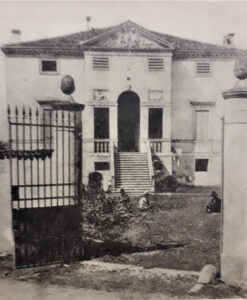 Villa Forni Cerato · Facciata
Datazione corretta: la villa è post 1568 Gira la schedaDatazione corretta: la villa è post 1568
Villa Forni Cerato · Facciata
Datazione corretta: la villa è post 1568 Gira la schedaDatazione corretta: la villa è post 1568La presunta data di costruzione, a lungo attribuita alla produzione giovanile di Palladio (circa 1541–42), è stata corretta grazie alle indagini scientifiche avviate dalla Fondazione. La villa viene ora collocata in un periodo post 1568, in piena maturità palladiana — un dato che cambia radicalmente la lettura critica dell’opera.
Research book Fonte: vicenza-unesco.com, 2021 -
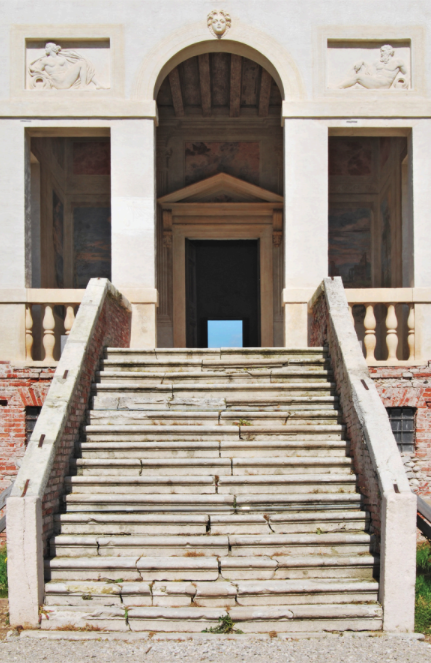 Scala esterna · 2026
Fondazioni e casa preesistente di Girolamo Forni Gira la schedaFondazioni e casa preesistente di Girolamo Forni
Scala esterna · 2026
Fondazioni e casa preesistente di Girolamo Forni Gira la schedaFondazioni e casa preesistente di Girolamo ForniLe indagini fondazionali hanno portato alla luce le strutture portanti della casa preesistente della famiglia Forni, su cui Palladio intervenne. L’edificio — identificabile come casa padronale originale — si trova a est del corpo villa e presenta caratteristiche costruttive di epoca precedente all’intervento palladiano.
Research book Le fondazioni di Villa Forni Cerato -
 Indagini esplorative · 2023
Fosse, cisterne e ceramiche antiche nel sito Gira la schedaFosse, cisterne e ceramiche antiche nel sito
Indagini esplorative · 2023
Fosse, cisterne e ceramiche antiche nel sito Gira la schedaFosse, cisterne e ceramiche antiche nel sitoLe indagini esplorative nelle aree nord-est e sud-est del sito hanno portato alla luce fosse e cisterne sia all’interno che all’esterno dell’edificio. All’interno della fossa principale sono stati rinvenuti frammenti di ceramiche antiche attualmente in fase di catalogazione e studio scientifico.
Research book Indagini archeologiche esplorative -
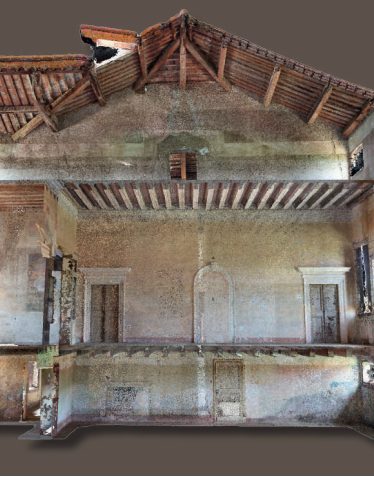 Pubblicazione VFC · 2022
Documenti d’archivio su Girolamo Forni e i busti dispersi Gira la schedaDocumenti d’archivio su Girolamo Forni e i busti dispersi
Pubblicazione VFC · 2022
Documenti d’archivio su Girolamo Forni e i busti dispersi Gira la schedaDocumenti d’archivio su Girolamo Forni e i busti dispersiLa ricerca d’archivio ha ricostruito le vicende di Girolamo Forni — mercante di legnami, fornitore di numerosi cantieri palladiani, pittore dilettante e membro dell’Accademia Olimpica di Vicenza. Il suo testamento del 1610 attesta la presenza originale di busti di Alessandro Vittoria ritraenti Forni e Pietro Bembo, poi dispersi nel tempo.
Research book Vicende storico critiche e documenti d’archivio -
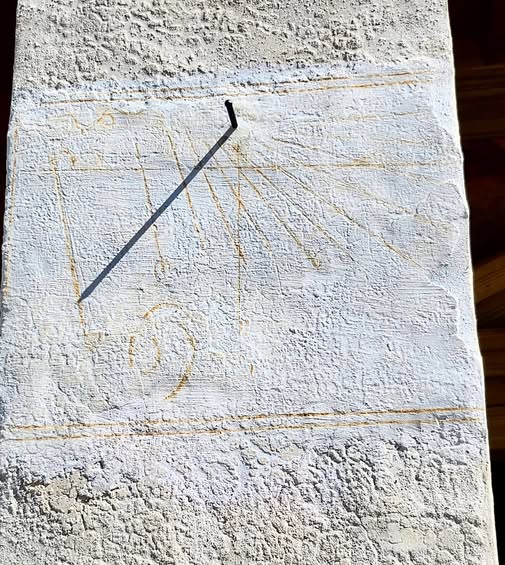 Studio meridiana · 2024
L’orologio solare e il sapere astronomico del committente Gira la schedaL’orologio solare e il sapere astronomico del committente
Studio meridiana · 2024
L’orologio solare e il sapere astronomico del committente Gira la schedaL’orologio solare e il sapere astronomico del committenteIl rilievo geometrico e astronomico della meridiana in facciata ha consentito di datarne più precisamente la realizzazione e di comprenderne il funzionamento rispetto all’orientamento originale dell’edificio. Lo studio apre nuove ipotesi sulla relazione tra il progetto palladiano e le conoscenze scientifiche di Girolamo Forni, membro dell’Accademia Olimpica.
Research book Studio dell’orologio solare -
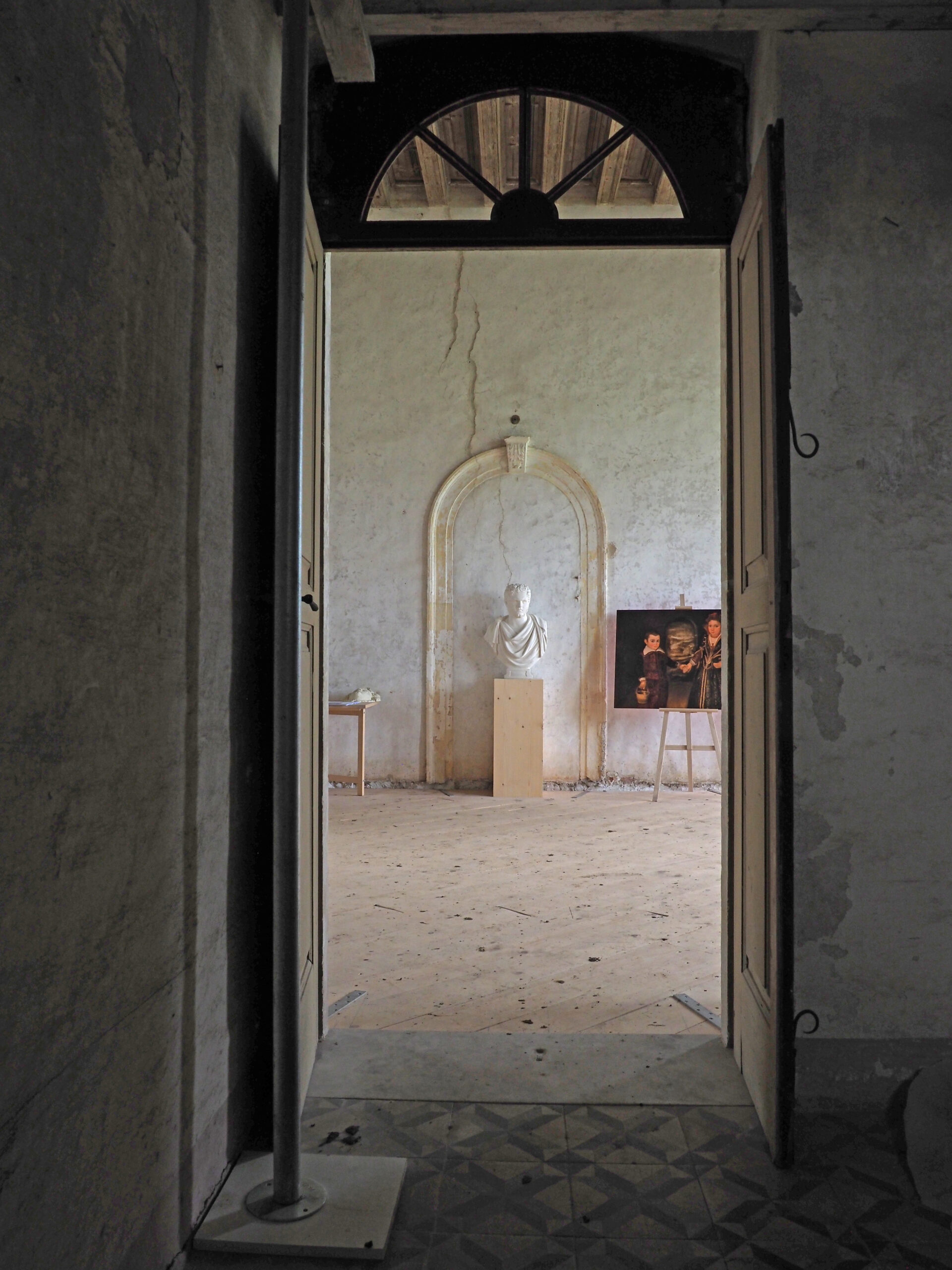 The Architectural Forum · 1921
Villa Forni Cerato su The Architectural Forum, 1921 Gira la schedaVilla Forni Cerato su The Architectural Forum, 1921
The Architectural Forum · 1921
Villa Forni Cerato su The Architectural Forum, 1921 Gira la schedaVilla Forni Cerato su The Architectural Forum, 1921La Fondazione ha individuato un approfondimento tecnico dedicato a Villa Forni Cerato pubblicato nel 1921 su The Architectural Forum, una delle riviste più autorevoli dell’architettura americana del primo Novecento. Il ritrovamento attesta il riconoscimento internazionale della villa settant’anni prima dell’iscrizione UNESCO.
Fonte: villafornicerato.it, dicembre 2025
DISCUSSION TABLE
For a PARTICIPATORY restoration
"We need to bring together around a table people with entirely different interests in the monument, led by a director, which I believe ought to be the public sector. Sitting around that table will be the historian, the analysts, and the specialists—who might range from the restoration chemist to the foundation engineering technician, the structural engineer, and the architect. Around that table, one person's logic is not another's. No single expert's voice can be deemed either winning or losing: it must be weighed against all the others, sparking a deep conflict in which the general public must also play its part."
Manfredo Tafuri — Casabella N° 580, 1991The Discussion table in numbers
TRANSPARENT ADMINISTRATION OF RESTORATION
Villa Forni Cerato simple company - Costs, bonuses and cumulative contributions
Cost of the RESTORATION (€)
| (€) | Until 2019 | Until 2020 | Until 2021 | Until 2022 | Until 2023 | Until 2024 | Until 2025 |
|---|---|---|---|---|---|---|---|
| Total costs for purchase and restoration | 399.000 | 537.000 | 972.000 | 1.657.000 | 2.173.000 | 2.279.000 | 2.356.000 |
| Of which — Bonus facades and earthquake | 0 | 0 | 185.000 | 265.000 | 318.000 | 382.000 | 382.000 |
| Of which — Ministerial contributions | 0 | 0 | 0 | 0 | 65.000 | 76.000 | 76.000 |
Restored with the contribution of the