Forni · Palladio · Vittoria
Three figures, three visions, a single legacy: the Villa as a meeting place between commission, architecture and art in the Vicenza Renaissance.Girolamo Forni
The Commissioner · Timber merchant · Humanist · Amateur painterThe only non-noble to commission a villa from Andrea Palladio. Direct supplier of the main Palladian construction sites of Vicenza, refined collector, portrait painter and member of the Olympic Academy of Vicenza.
Girolamo Forni, known as Girolamo della Grana or dai Forni, was born in Montecchio Precalcino around 1530. Orphaned at an early age, he was helped by his uncle, Friar Giampietro dai Forni of the Conventual Franciscans. He built a fortune on his own in the timber trade, becoming a direct supplier to Andrea Palladio for the construction sites of the Basilica Palladiana, Palazzo Chiericati, the Cathedral of Vicenza, Villa Almerico Capra, and Palazzo Barbaran da Porto.
Portrait painter - the historian Marzari in 1604 remembered him as "very excellent, maxims or portraits" - art collector, real estate developer. He was a member of the Olympic Academy, where he provided timber for the Olympic Theater, and was represented as a statue in the attic of the stage in front.
On September 27, 1576, during the great plague of Venice, Forni organised - paying out of his own pocket - the rescue of his friend Alessandro Vittoria, having him secretly led to the Vicenza native from Venice. The sculptor was a guest in the Montecchio villa for almost a year.
He died in Vicenza on January 27, 1610. His will expresses the wish that the villa should be preserved intact for future generations.
«E perché mi atrovo haver nella villa de Montechio Precalcino una possessione con belle buone e honorate fabriche sopra… voglio che siano sottoposte a strettissimo fideicommisso e proibisco affatto ogni alienatione di quella manco in una minima parte.»
Will of Girolamo Forni, January 10, 1610 — State Archives of VicenzaGirolamo Forni Merchant from Vicenza supplier of Palladio — by Villa Forni Cerato Foundation, presentation by Rita Francesca Grandi, Biblos Edizioni, 2022
Girolamo Forni
Entrepreneur, merchant, collector, painter
A biography that gives voice to Girolamo Forni: from his years of youth to his rise as a timber merchant and supplier of the most important Palladian shipyards, up to the maturity as a collector, amateur painter and client of the villa that bears his name.
The volume reconstructs (partly through the narrative voice of Forni himself) the journey of a non-noble man capable of earning a place among the Vicentine elites of the late sixteenth century: from his beginnings in the timber trade to becoming a direct supplier for Andrea Palladio's construction sites, from the Basilica to Palazzo Chiericati, and from the Cathedral to Villa Almerico Capra. One chapter is dedicated to his friendship with Alessandro Vittoria, another to his relationship with Palladio as a client, and yet another to the creation of the villa in Montecchio, "the house of his dreams."
The biography also includes infographics on Palladio's noble clients, on his works in the center of Vicenza and on the twenty-four Venetian villas, as well as a rich documentary apparatus: the full transcript of the 1610 will, the inventory of the assets in Montecchio Precalcino and a reasoned bibliography available to scholars.
The works of Girolamo Forni
Here are the twenty works today attributed to Girolamo Forni: a collection of portraits that cross international museums and private collections. Browse the gallery and select a painting to discover its history.
20 Attributed paintings · select a work for the complete card
Opera 01 di 20
Family portrait
- Collocation
- Metropolitan Museum of Art, New York (not exhibited)
- Date
- —
- Dimensions
- —
- Provenance
- The Crosby Brown Collection of Musical Instruments, 1889
Descriptive sheet in preparation.
Opera 02 di 20
Portrait of Isabella Thiene Valmarana
- Collocation
- Civic museums of Vicenza — Palazzo Chiericati
- Date
- 1594
- Dimensions
- 114,8 × 97,4 cm
- Provenance
- Legato Umberto Rinaldi, 1938
Isabella Valmarana, daughter of Leonardo and niece of Gianalvise, is portrayed here on the occasion of her wedding to Ludovico Thiene. They suggest this event the jasmine in the hair and the flowers pinned on the shoulder, perhaps a wish for a happy union; the pink dress was fashionable in this shade for the brides of the time.
As in the portrait of the Valmarana family, a symbol underscores the importance of musical education: the young woman holds a mandola, a plucked string instrument that is a precursor of the mandolin. The work was painted by Girolamo Forni, a close friend of Leonardo, to whom Marzari (1604) recognized the gift of 'portraying men naturally, although he is not a painter by profession, nor has he ever devoted himself to painting.
The painting is meticulous in the exterior image: the Spanish dress with a pointed bodice profiled by a large golden cord, the face illuminated by a white linen gorget, the hair gathered in a tall hairstyle adorned with flowers, a large gold necklace ended with an old-fashioned medallion from which hangs a large pearl.
Opera 03 di 20
Portrait of Beatrice by Sertorio Capra
- Collocation
- Private collection, Vicenza
- Date
- —
- Dimensions
- —
- Provenance
- —
Descriptive sheet in preparation.
Opera 04 di 20
Portrait of a lady
- Collocation
- Tadini Academy of Fine Arts, Lovere (BG)
- Date
- 1582
- Dimensions
- 114 × 88 cm
- Provenance
- —
«A two-third portrait of a standing figure of a richly dressed matron. Paolo Veronese's work performed in the year 1582 while the woman was 44 years old, as we read behind the painting» (Luigi Tadini, 1828).
The noblewoman wears an overgarment of intense pink, quilted with elegant embroidery and paired, in luminous contrast, with a silver silk dress featuring gold braiding wound in spirals around the sleeves. Her face, bearing a composed and focused expression, is framed by the crisp white collar with finely pleated ruffs. Her right hand rests on her chest, while over her arm she carries a fur pelt
The jewels - pearl and gold necklaces, earrings with small bows of the same pink as the dress, a wedding ring and a ring with translucent stone - denote belonging to a high social class, in the contained elegance imposed perhaps by the rigourous sumptuous Venetian laws. The quirk of pearls, reserved in the Serenissima to wives or promised brides, denotes the status of married woman.
The dark background, expertly used to enhance the bright colours of the clothes, is moved by a curtain with brown reflections; the three-quarter pose allows you to appreciate the figure and breadth of the clothes. No clue reveals the identity of the lady. Giorgio Fossaluzza owes the attribution of the painting to Girolamo Forni.
Opera 05 di 20
Portrait of a noble young man
- Collocation
- Civic Museums of Vicenza (not on display)
- Date
- —
- Dimensions
- 86,5 × 68,5 cm
- Provenance
- Legato Umberto Rinaldi, 1938
Descriptive sheet in preparation.
Opera 06 di 20
Portrait of a young man
- Collocation
- National Gallery of Ireland, Dublin
- Date
- —
- Dimensions
- 107 × 98 cm
- Provenance
- —
Descriptive sheet in preparation.
Opera 07 di 20
Federico by Fabrizio Loschi
- Collocation
- Private collection, Vicenza
- Date
- —
- Dimensions
- —
- Provenance
- —
Descriptive sheet in preparation.
Opera 08 di 20
Portrait of Canon Marcantonio Capra
- Collocation
- Civic Museums of Vicenza (not on display)
- Date
- —
- Dimensions
- 117 × 91 cm
- Provenance
- Dono Antonio Barbaran Capra, Vicenza 1873
Belonging to a noble and powerful family, doctor in utroque iure, and apostolic protonotary, Marcantonio Capra was a prominent figure in the Vicentine Church between the sixteenth and seventeenth centuries; from 1609 to 1618 he served as Vicar General to Bishop Dionisio Dolfin (Mantese, 1974).
Depicted in three-quarter view against an indistinct background, the sitter turns his gaze toward the viewer, resting his right hand on a book bound in red leather and placing his left hand on his belt. He wears an elegant black cloak lined with sable fur, visible along the hem and collar; the white neckcloth illuminates the face, which is rendered with precision yet appears rather static and inexpressive.
The attribution to Alessandro Maganza, repeated in museum inventories, raises doubts. Significant affinities exist, however, with the portrait of Isabella Thiene Valmarana—in the composition, the attention to detail, and the rendering of the face and inert hands—which suggest including the portrait in the catalogue of Girolamo Forni, dating it between the final decade of the sixteenth century and the first decade of the seventeenth, during the artist's full maturity.
Opera 09 di 20
Female portrait
- Collocation
- Musée des Beaux-Arts, Chambéry (Francia)
- Date
- —
- Dimensions
- 73,2 × 56,2 cm
- Provenance
- Collezione H. Garriod
Inscription at the top left of the canvas: ORNELIA GEORGII ? IS XIVLII ETATIS. Acquired in 1886. Attribution of Federico Zeri.
Opera 10 di 20
Female portrait
- Collocation
- Civic Museums of Padua (not on display)
- Date
- —
- Dimensions
- 111 × 97 cm
- Provenance
- Legato Carlo Fantoni
Now attributed to Francesco Montemezzano. Acquisition of 1932.
Opera 11 di 20
Portrait of Lodomilla Porcia
- Collocation
- Thiene Castle, Porto Collection
- Date
- —
- Dimensions
- —
- Provenance
- —
Work attributed to a late Mannerist painter, probably Girolamo Forni. Lodomilla married Nicolò Porto in 1587 and remained a widow in 1591 with three children.
She wears an overcoat with short sleeves that end immediately after the shoulder, slightly open on the sleeves of the petticoat. The horizontal striped decoration shows the "S" elements typical of the last quarter of the sixteenth century; the ruff, with a beaten and starched Baptist canvas with eight contrasts, is of considerable size, datable to the end of the century. The hair is gathered in a hairstyle slightly inspired by the " Venetian horns".
Opera 12 di 20
Portrait of Bianca Cappello
- Collocation
- Private collection, Florence
- Date
- —
- Dimensions
- 114 × 88 cm
- Provenance
- —
Descriptive sheet in preparation.
Opera 13 di 20
Female portrait
- Collocation
- Unknown location
- Date
- —
- Dimensions
- 22,5 × 14 cm
- Provenance
- —
Descriptive sheet in preparation.
Opera 14 di 20
Portrait of the Munarini children
- Collocation
- IPAB, Vicenza
- Date
- —
- Dimensions
- 100 × 118,5 cm
- Provenance
- Lascito Francesco Munarini
Children depicted on their own, unaccompanied by adults: a rather unusual iconography in Vicentine painting. The young figures stand out against an indistinct gray background. The little boy holds a bird in his right hand, recalling a popular children's pastime of the era, and points to the girl with his left; she offers a branch of jasmine and holds a bussolà. Beside the boy stands a small dog.
Particular attention is paid to the clothing, which denotes the social status and allows the painting to be dated to the early seventeenth century. The boy, with short hair, wears a doublet cinched at the waist by a belt with a gold buckle, and puffed breeches tied at the knee with a pink ribbon, along with tight-fitting hose and shoes with rounded toes. The somber outfit, edged with a dark green cord, is enlivened by the turned-down collar and white sleeves decorated with motifs in blue, brown, and pink.
The girl wears a white robe - the shadows would make you think of satin - with a low-cut and pointed bodice and a ruffled skirt, adorned with coral pink ribbons; the sleeves take up patterns and colours of those of the child. The collected hair is adorned with flowers. Authentic miniature lady, the little one sports a coral necklace and small golden spheres, coral bracelets on her wrists, a ring on the little finger of her left hand.
Opera 15 di 20
Portrait of two children
- Collocation
- Private collection
- Date
- —
- Dimensions
- 84 × 114 cm
- Provenance
- —
Descriptive sheet in preparation.
Opera 16 di 20
Ritratto di dama con fanciullo
- Collocation
- Museo d’Arte Medioevale e Moderna, Museo Eremitani, Padova
- Date
- —
- Dimensions
- 112 × 94 cm
- Provenance
- Legato Leonardo Emo Capodilista
Descriptive sheet in preparation.
Opera 17 di 20
Portrait of ladies of the Giusti del Giardino family
- Collocation
- Private collection
- Date
- —
- Dimensions
- 129 × 135 cm
- Provenance
- —
Descriptive sheet in preparation.
Opera 18 di 20
Portrait of a Venetian lady
- Collocation
- Historical Museum of Miramare Castle, Trieste
- Date
- —
- Dimensions
- 103 × 108 cm
- Provenance
- Villa veneta
Female figure. The name of the painter is written on the top of the frame and the title of the work at the bottom.
Opera 19 di 20
Portrait of Cesare Franco
- Collocation
- Private collection, Bologna
- Date
- —
- Dimensions
- —
- Provenance
- —
Portrait of a Gentleman with Scroll, attributed to the Venetian School; according to the restorer, the painting has been cropped at the bottom and on the right.
The analysis of the epigram—which was altered several times—suggests that the second line did not indicate a dedication to the Most Serene Prince, but rather the profession of the sitter: Master Architect (Proto). A composite letter resembling an F and a C at the beginning of the inscription makes a reference to the stonecutter, plaster decorator, and architect Cesare Franco from Padua plausible. Franco was a close collaborator of Scamozzi and a business partner of the sculptor Girolamo Campagna, and in the 1590s he held the position of Proto Architect at the Procuratoria di San Marco de Ultra.
Due to its jagged edges, the object held between the sitter's fingers would suggest not a scroll, but rather a square of wax or a tablet of white lead—the former used for polishing, the latter a component of Venetian stucco along with slaked lime putty. Two small letters, 'SR', inserted between the name and the adjective Maximus, would appear to refer to the acronym for 'Stuccador' (stuccoworker) or 'Scultor' (sculptor)."
Opera 20 di 20
Self-portrait of a full-length man
- Collocation
- Villa Forni Cerato, Montecchio Precalcino (VI)
- Date
- —
- Dimensions
- 190,5 × 116,5 cm
- Provenance
- Collection aor from a villa in the province of Padua
Portrait of a gentleman with a beard and a high forehead. He is accompanied by a small dog and wearing a brocade suit. He holds the black hat in his hand, probably as a sign of respect for the noble guests. Behind you can see two big books, perhaps masters of work.
Reasoned bibliography
Chronological collection of sources and documentary notes dedicated to Girolamo Forni, client of Villa Forni Cerato.
Andrea Palladio
The architect · Author of 24 Venetian villas · UNESCO HeritageThe most influential architect in Western history. Villa Forni Cerato is the only villa in its corpus commissioned by a certainly rich but not noble owner — a unique case in the entire Palladian work.
Born Andrea di Pietro della Gondola in 1508 in Vicenza, the future Palladio was trained in the workshop of the Lapicida from Vicenza Giovanni di Giacomo da Porlezza. The meeting with the noble humanist Giangiorgio Trissino - who gave him the classic name Palladio - opened the doors to the study of the ancient, trips to Rome and the frequentation of the most important Vicenza clients.
The Palladian paternity of Villa Forni Cerato, not attested or denied by any document, is today an almost closed issue in the scientific literature. Favourable to the attribution: Pane, Ackerman, Puppi, Burns, Battilotti and Beltramini.
The villa is part of the phase of maturity of Palladio's language: the three-arched loggia, the proportional ratio between forebody and main body, the chimneys with grooved volute stones resting on lion's feet - all elements attributable to the corpus of the fifties and sixties of the sixteenth century.
«Le bellezze delle fabriche nascono dalla forma e dalla corrispondenza del tutto alle parti, e delle parti tra loro.»
The Four Books of Architecture, 1570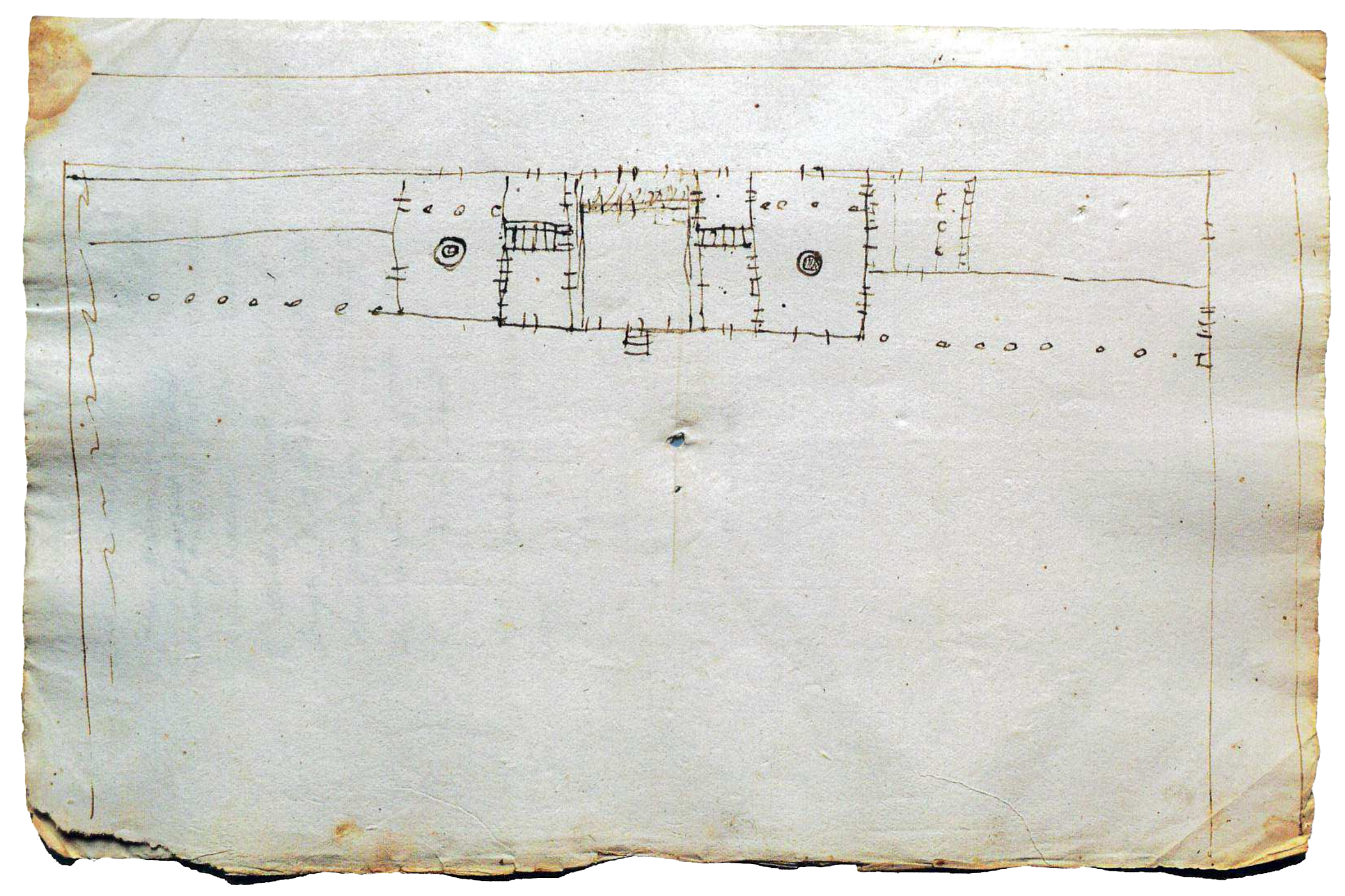
Notary Giovanni Maddalena, b. 458, June 25, 1562, State Archives of Vicenza.
The Sketch of
25 June 1562
A drawing in pen and brown ink, drawn on the back of a notarial deed, opens one of the most significant tracks for the Palladian reading of Villa Forni Cerato.
On June 25, 1562, the notary Giovanni Maddalena asks for a paper deed for Leonardo Dal Grumo. On the side of the document is traced the plan of a villa with rustic annexes, without any connection with the content of the deed.
Howard Burns observes that conventional signs coincide with those used by Palladio. The VFC Foundation then published a systematic study: dimensions, forometrics and layout of the pre-existing house in Forni show a significant correspondence; the external widths differ by only 8 cm.
Read the dedicated researchSources in the Foundation's collection
- Muttoni F., Architettura di Andrea Palladio Vicentino, Venice 1740–1748 — first printing attribution to Palladio
- Bertotti Scamozzi O., Le fabbriche e i disegni di Andrea Palladio, Vicenza 1776–1783 — first published metric survey of the Villa
- Moro M., Litografia della facciata di Villa Forni Cerato, 1847 — original Victoria decorations still in situ
- Burns H., in Palladio, Marsilio Editori, 2008 — analysis of the sketch of June 25, 1562
- Villa Forni Cerato Foundation, Lo schizzo di Andrea Palladio per Villa Forni Cerato, Research notebook, March 26, 2023
Alessandro Vittoria
The sculptor · Student of Sansovino · "Cordialissimo friend" by ForniThe greatest Venetian sculptor of the sixteenth century. His presence at Villa Forni Cerato is attested by the will of Girolamo Forni and confirmed by the surviving elements: the two monumental fireplaces in situ, the female head on the keystone, and the bas-reliefs of the loggia.
Alessandro Vittoria was born in Trento in 1525 and trained in Venice in the workshop of Jacopo Sansovino, with whom he collaborated until his breakup in 1551. He became the most famous sculptor of the Serenissima, known above all for the busts-portraits and for the plastic decorations of the buildings of Palladio.
His stay in Vicenza from 1576–77, guest of Girolamo Forni in the villa of Montecchio, is documented by Zorzi. Forni's will of 1610 mentions him as a "very cordial friend" and speaks of the "stucco portrait" and the bust of Cardinal Bembo as his works to be preserved.
1924 marked an irreparable loss: the then owner sold the four bas-reliefs of the Four Seasons and the coat of arms with the two Hungers in the tympanum. The Foundation has launched a systematic campaign to locate the missing works.
«Ordino e Prego li miei Commissarii che faccino accomodar… la mia testa e ritratto di stucco… quale come fattura del già sig. Alessandro Vittoria mio cordialissimo Amico meritano d’essere conservate.»
Will of Girolamo Forni, January 10, 1610Rebirth of sculptural works related to the Villa
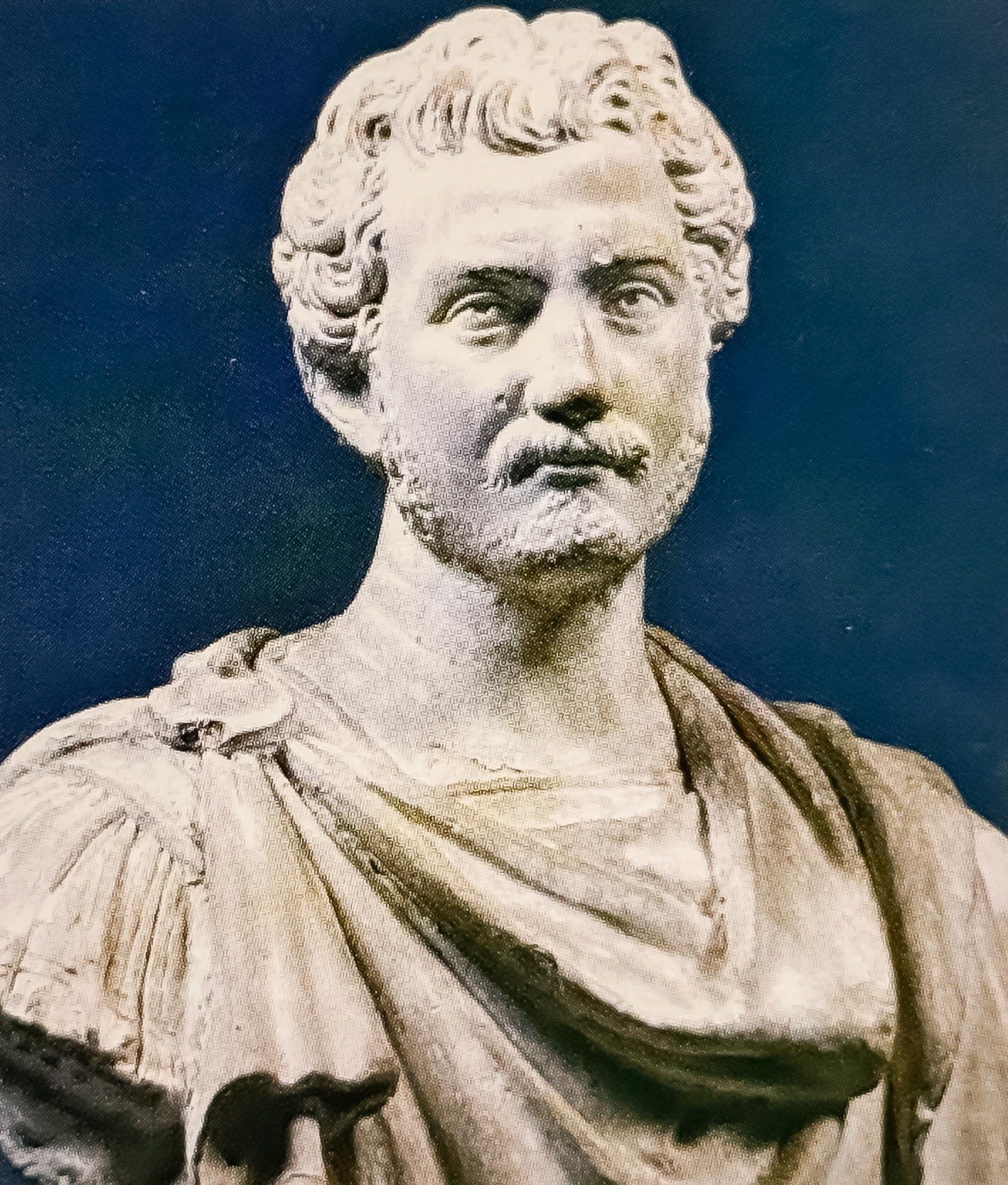
Bust Emperor Caracalla
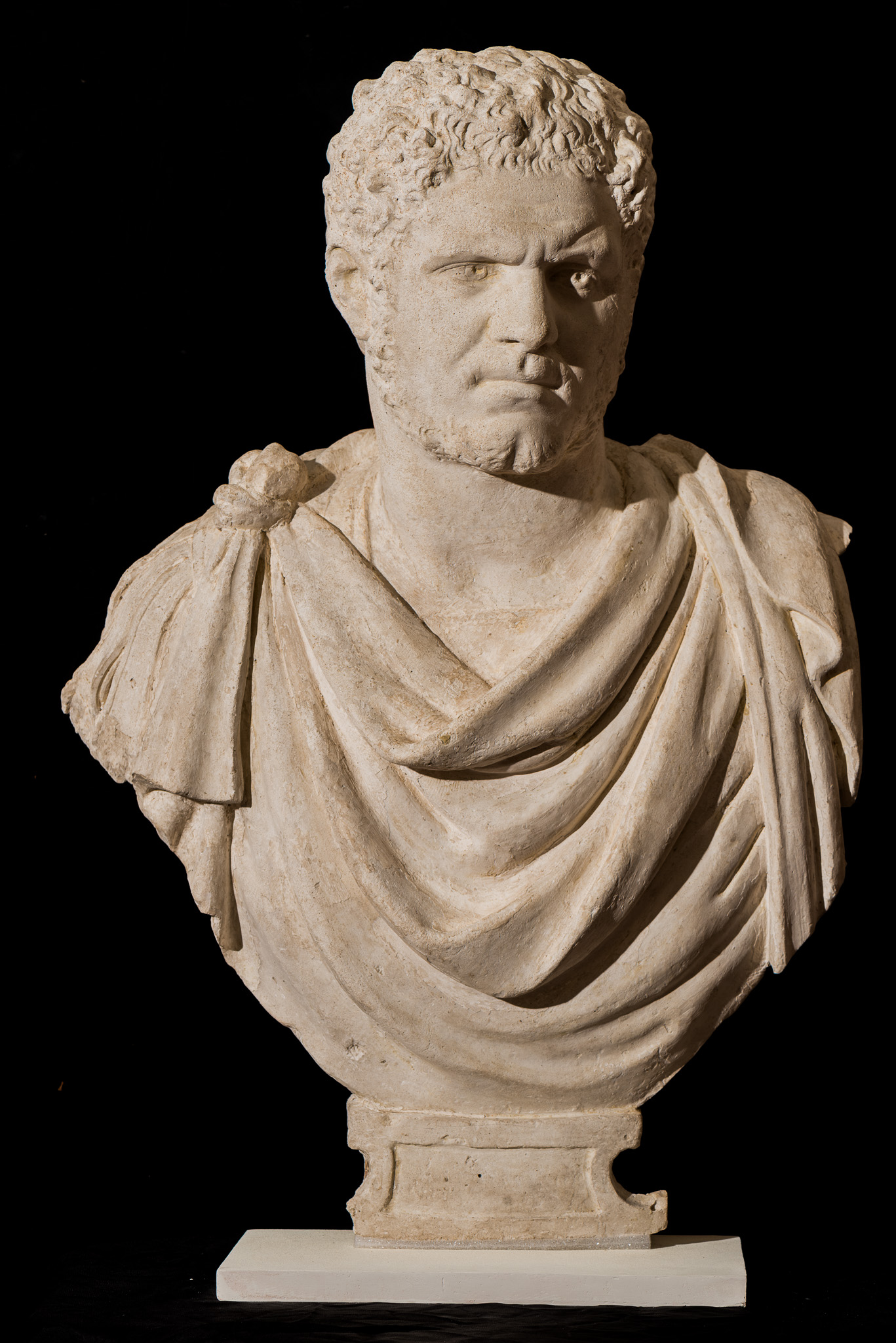
In his will of 1610 Girolamo Forni expressly asks his commissioners to have "my head and stucco portrait" restored, the work of his "very cordial friend" Alessandro Vittoria.
Head of Medusa
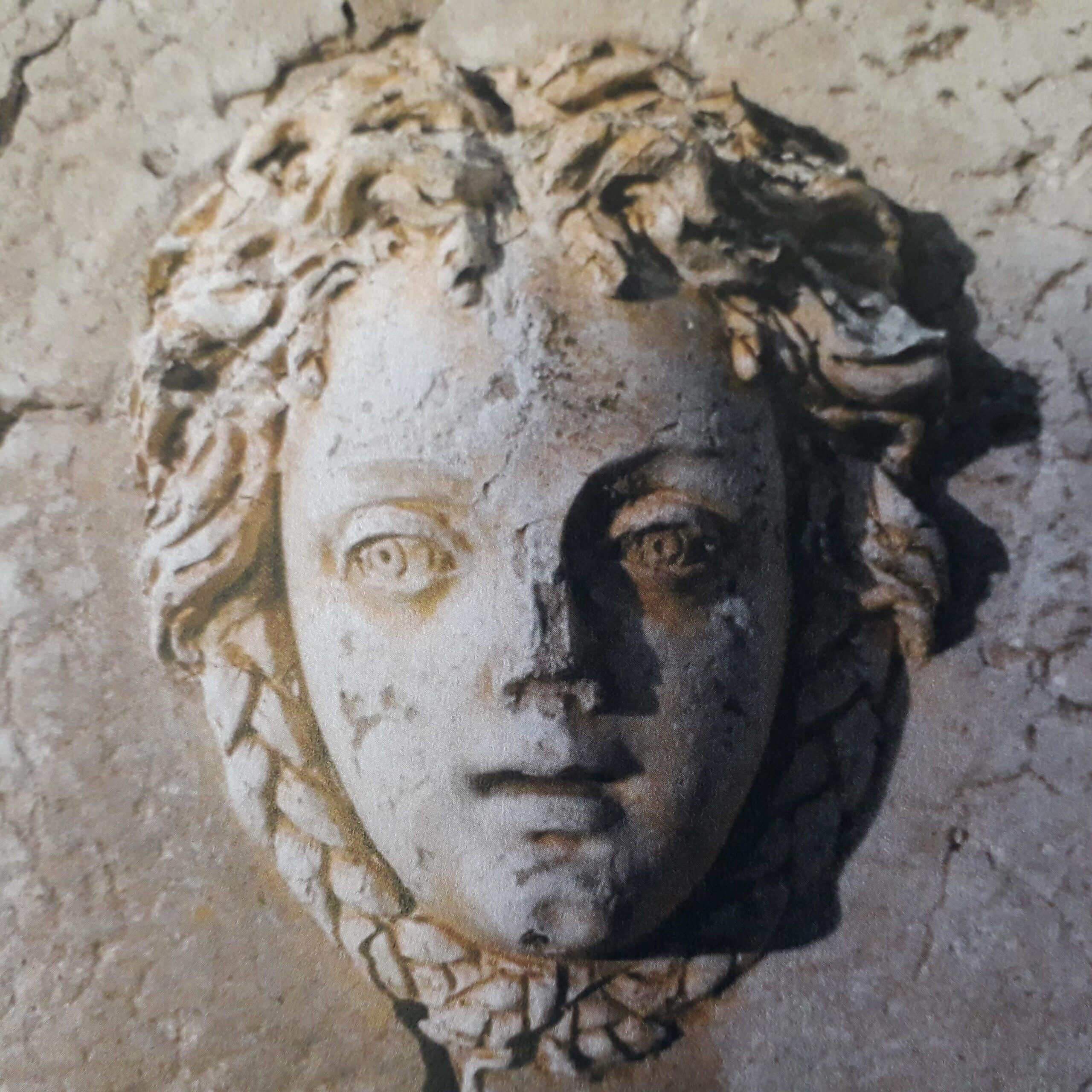
Per lungo tempo interpretata come una Medusa, la testa posta in chiave all’arco centrale della serliana raffigura in realtà un volto di donna, con i capelli sciolti sulla fronte e legati in trecce a incorniciare il viso. L’opera è attribuita ad Alessandro Vittoria: secondo Zorzi sarebbe stata eseguita nel 1576, durante il soggiorno dello scultore a Montecchio come ospite di Girolamo Forni. È modellata in stucco, con un’anima in malta di calce e inerti grossolani, rivestita in intonaco liscio bianco e dipinta di giallo a imitazione della pietra. Fu l’unica opera dell’apparato scultoreo della facciata a non essere venduta nel 1924. Il campione di pulitura, che ha rimosso l’attacco biologico dalle pieghe dell’acconciatura e dalla fronte, ne ha restituito la plasticità e la buona fattura.
Bust "L'Orientale"
The sculptural work is witnessed present in Villa Forni Cerato until the nineteenth century. It was then sold to private individuals and is now in a private collection.
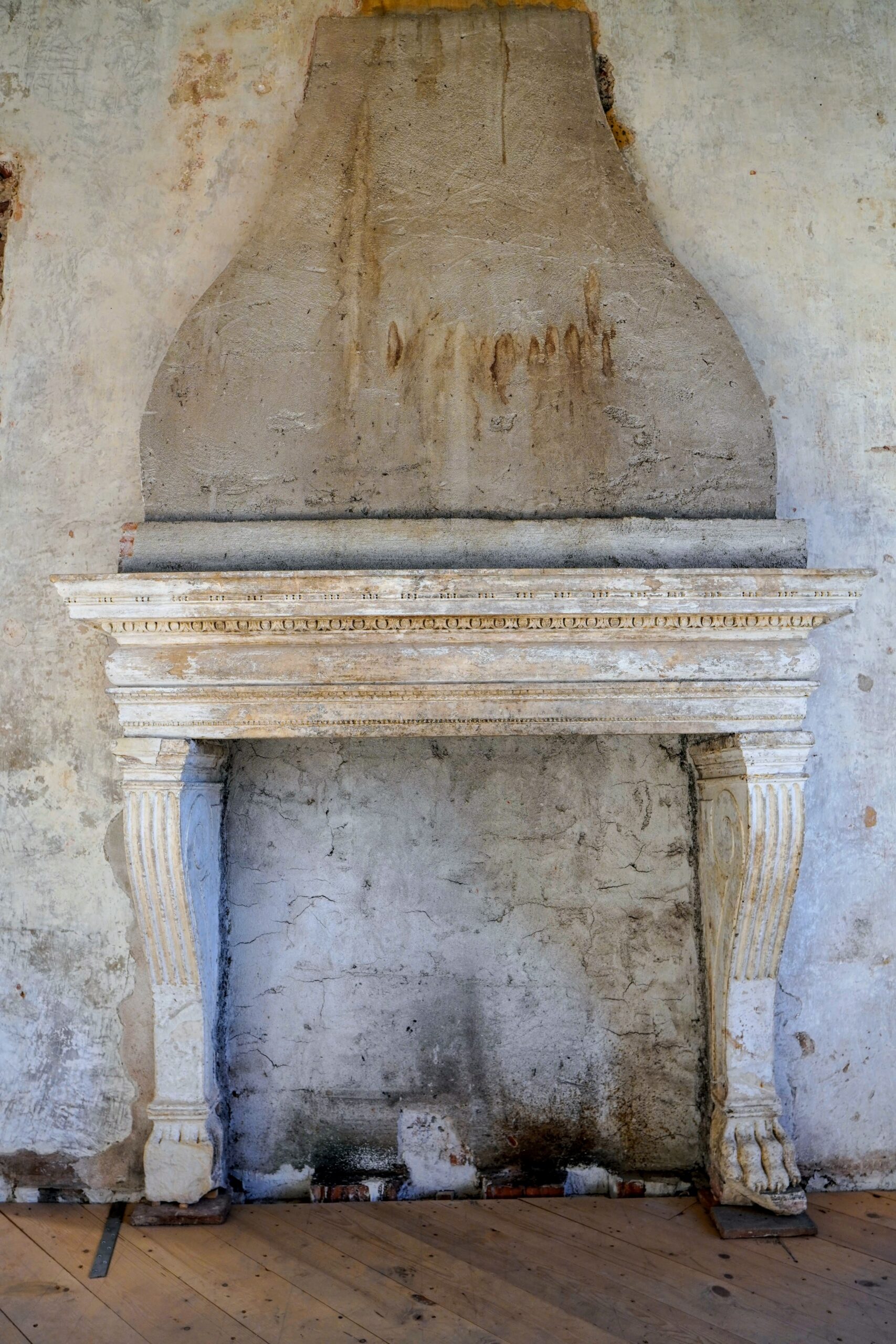
East Fireplace
In the east corner room of the main floor is one of the two monumental fireplaces of the Villa, with slotted volute stones resting on lion's paws: a decorative language consistent with the corpus of Alessandro Vittoria and with his documented stay in the Villa in 1576–77.
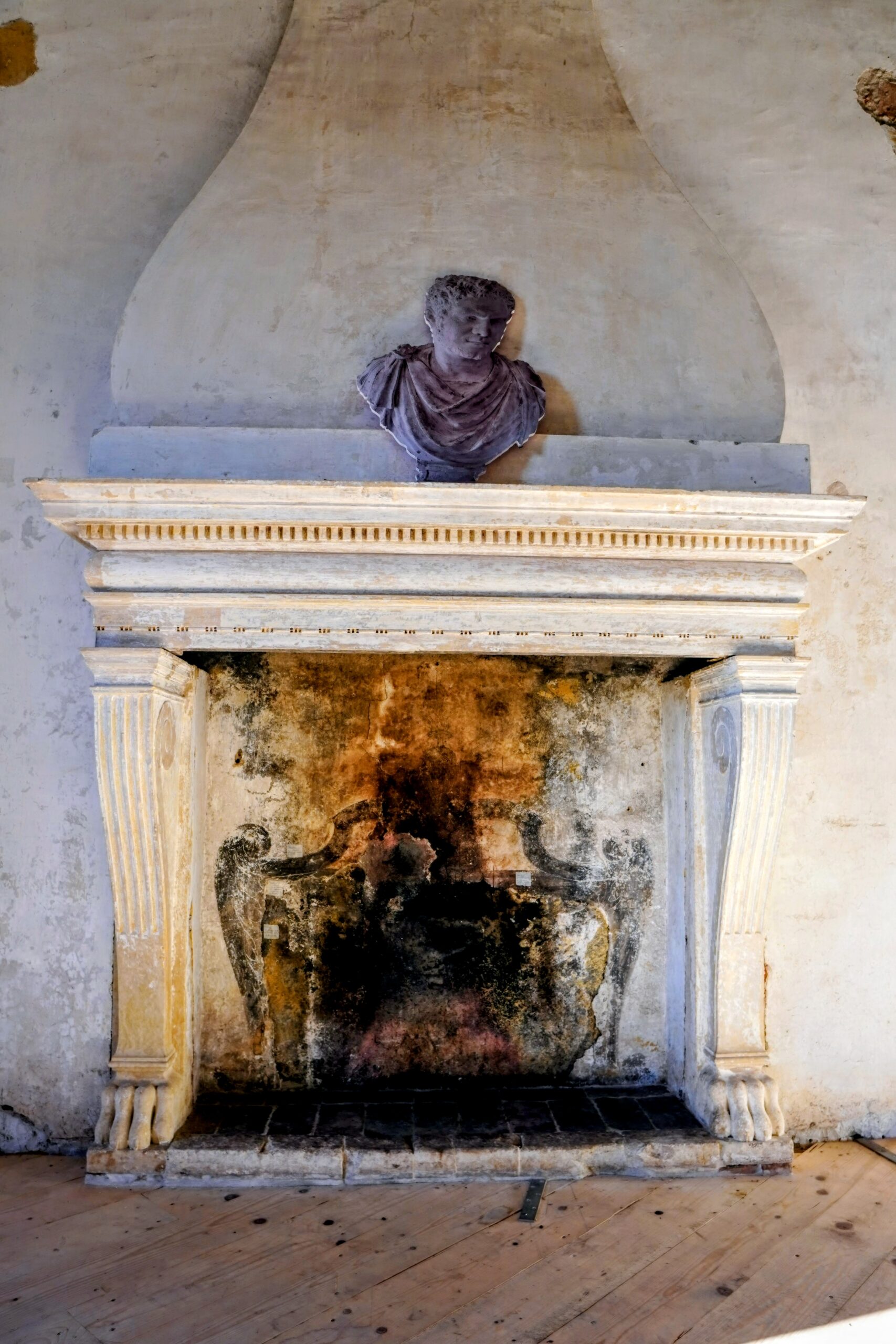
West Fireplace
In the western corner room of the main floor, the second of the two monumental chimneys of the Villa is preserved, twin of the eastern one for workmanship and for the same decorative language consistent with the corpus of Alessandro Vittoria.
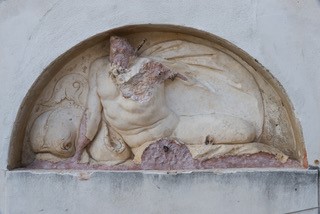
Bezel with Neptune
In 2024, restoration work led to the discovery of a bas-relief above the entrance door of the western dovecote tower, which had presumably been walled up around 1904—a story passed down from father to son that has reached us today. The work depicts Neptune, the God of the Sea, alongside a dolphin. The protruding parts—the head, left arm, and right leg—have been lost. The piece can likely be attributed to the same author as the other sixteenth-century sculptures in the villa, namely Alessandro Vittoria